
인터럽트, 시스템 구조, 운영체제 아키텍처 - Operating System 1-1
운영체제가 무엇을 관리하는지, 인터럽트가 실행 흐름을 어떻게 바꾸는지, 그리고 이 구조가 이후 OS 학습의 기반이 되는 이유를 정리합니다.
인터럽트, 시스템 구조, 운영체제 아키텍처 - Operating System 1-1
운영체제가 무엇을 관리하는지, 왜 인터럽트가 핵심인지, 그리고 이후 프로세스·스레드·메모리 개념이 어떤 기반 위에 올라가는지 먼저 잡는 글이다.
What this post covers
- 운영체제가 하는 역할과 시스템 전체 구조
- 인터럽트가 CPU 실행 흐름을 바꾸는 방식
- 저장장치 계층과 컴퓨터 시스템 아키텍처의 큰 그림
Operating System(OS)
여러 서비스들을 유저들과 응용프로그램을 하드웨어가 사용할 수 있도록 도와주는 역할
Definition of OS
- 보는 관점에 따라 다를 수 있음 (사용자 <-> 개발자)
- 운영체제가 있는 이유: 하나 컴퓨터마다 하나의 프로그램만 작동하지 않음.
- 여러 프로그램을 하드웨어 같은 인프라를 가지고 효율적으로 돌리기위해 운영체제가 필요.
- 작은 메모리(RAM)만 가지고도 여러 프로그램을 돌릴 수 있음.
- Mobile devices like smartphones and tablets are resource poor, optimized for usability and battery life
- 모바일은 성능이 더 작으니 resource poor 하고, 배터리를 잘 관리하기 위해 운영체제가 여기에 맞춰 개발됨.
- 심지어 가전제품 등에도 CPU가 있고 OS도 있음. OS의 시발점은 군사용이었음.
Concept of OS
- No universally accepted definition
- “The one program running at all times on the computer”is the kernel, part of the operating system
- 그외 나머지는 system program(ships with the os, but not part of the kernel) 또는 application program(all programs not associated with os)이다.
- middle ware: 개발자들을 위해 API를 제공해주는 계층, 사용자들이 보는 것보다 추상화되어 있음. 예시: 쿼리 등
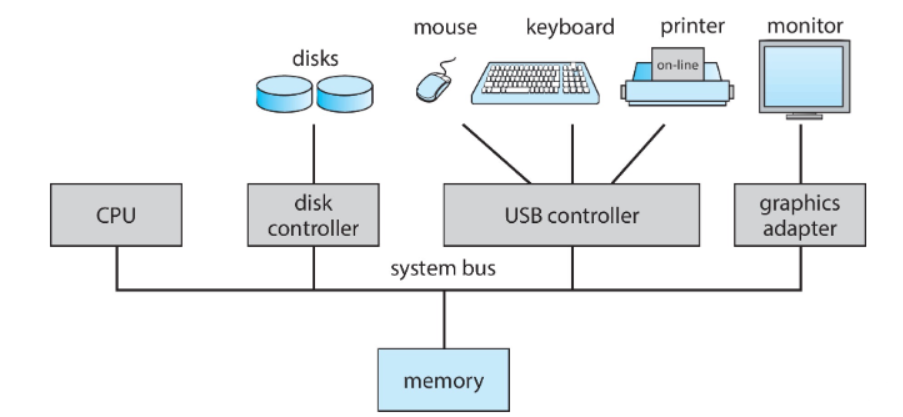
Computer System Organization
- 각각 system bus로 연결되어 있고, 이를 통해 다 연결이 되어 동시에(Concurrent) 운영이 된다.
- Concurrent 과정에서 충돌은 피할 수 없다. 특히 메모리에 접근할 경우에 충돌은 빈번해서 메모리 접근은 느릴 수 밖에 없음.
- I/O devices and the CPU can execute Concurrently
- Local Buffer 는 I/O device를 제어하기위한 컨트롤러 이다.
- 함수 또는 특정 코드 블록 내에서 선언된 임시 저장 공간으로, 스택(stack) 메모리에 저장됨.
- Each device controller type has an operating system device driver to manage it
- CPU moves data from/to main memory to/from local buffers. (컴퓨터 시스템에서 어떤 계산이든 CPU를 통해서 이루어 진다. 데이터의 이동조차.)
- Device controller informs CPU that it has finished its operation by causing an interrupt.
그럼 CPU들이 모든 일에 어떻게 관여하는가??
그걸 가능하게 하는게 Interrupt 이다.
Interrupt
- Interrupt는 ‘방해하다’라는 뜻처럼 CPU가 하는 행위를 방해해서 여러 개의 일을 할 수 있도록 함.
Function of Interrupt
- Interrupt transfers control to the interrupt service routine generally,
through the interrupt vector, which contains the addresses of all the service routines- 어떤 사건이 발생한 것을 알려주기 위해 CPU를 갑자기 중단을 시킴. 마우스를 움직이면 마우스I/O에서 CPU에 interrupt를 검.
그럼 CPU가 멈추고 변경된 것을 반영. 이 과정의 코드 가 interrupt service routines 이다.
- 어떤 사건이 발생한 것을 알려주기 위해 CPU를 갑자기 중단을 시킴. 마우스를 움직이면 마우스I/O에서 CPU에 interrupt를 검.
- 디바이스마다 interrupt가 있는데, 각 interrupt를 구별하기 위해 interrupt vector 가 있다.(즉, interrupt의 index 역할)
- A trap or exception is a software-generated interrupt.
- OS is interrupt driven.
- interrupt의 종류가 너무 많아서 계층 구조를 가진다. vector에서 번호가 하나만 주어지는 게 아니라, 그 주소의 table이 또 있다.(ex: 외과에도 셩형외과, 일반외과 있는 것처럼)
CPU가 interrupt가 걸린지 어떻게 아는가?
- The CPU hardware has a wire called the interrupt-request line that the CPU senses after executing every instruction. (interrupt는 대략 1초에 2천번 정도 이루어 진다.)
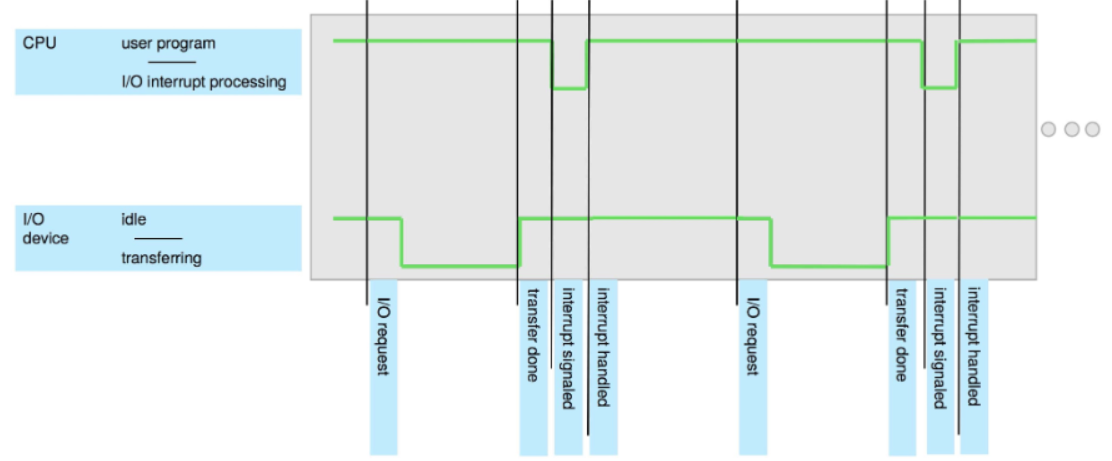
interrupt_timeline
Interrupt Handling
- CPU가 interrupt가 걸리면 실행하던 코드를 멈추고 다른 코드를 실행함.
그리고 원래의 상태로 돌아가기 위해 registers (어느 하나의 register가 아니라 resgister의 집합)를 저장함.
interrupt 방식.
- polled interrupt system
- interrupt가 오면 확인하는 방식
- vectored interrupt system
- interrupt에 번호가 따라오는 방식(대부분 vector 사용)
Two interrupt request line
- nonmaskable interrupt: unrecoverable errors(무조건 걸리는 interrupt)
- maskable interrupt: can be turned off(안받아도 되는 interrupt)
- Interrupt chaining: each element in the interrupt vector points to the head of a list of interrupt handlers.
- vector의 크기를 줄이기 위해 계층 구조를 가지고 있다.
- interrupt의 우선순위가 있는데 interrupt priority level 이라 하고 우선순위대로 실행됨.
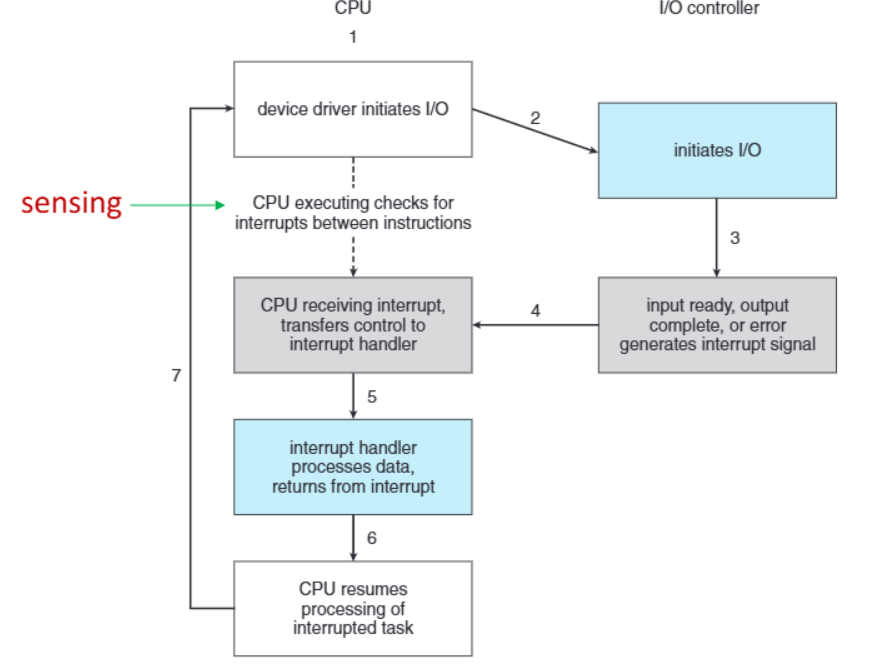
Interrupt-drive I/O Cycle instruction중에 sensing을 통해 interrput 여부 확인 interrupt는 OS의 multitasking등을 이해하기 위한 기초
Storage Structure
- main memory: only large storage media that the CPU can access directly
- Random access
- Typically volatile(휘발성)
- Typically random-access memory in the form of Dynamic Random-access Memory(DRAM)
- Secondary storage: extension of main memory that provides large nonvolatile(비휘발성) storage capacity
- HDD(Hard Disk Drives): logically divided into tracks, which are subdivided into sectors
- NVM(Non-volatile memory) devices = SSD: faster than hard disk, Nonvolatile, Varios technologies, Becoming more popular(as capacity and performance increases, price drops).
Storage Definitions and Notation
- bit: The basic unit of computer storage.
- byte: Is 8bits, the smallest convenient chunk of storage
- word: size of CPU’s register(ex: 1word = 8byte in 64bits CPU) (octec = 8 bit = 1 byte)
Stroage Hierarchy
Storage systems organized in hierarchy(계층 구조)
- speed: program
- cost
- volatility
- Caching: copying information into faster storage system
- Main memory can be viewed as a cache for secondary storage
- Device Driver: For each device controller to manage I/O
- Provides uniform interface b/w controller and kernel
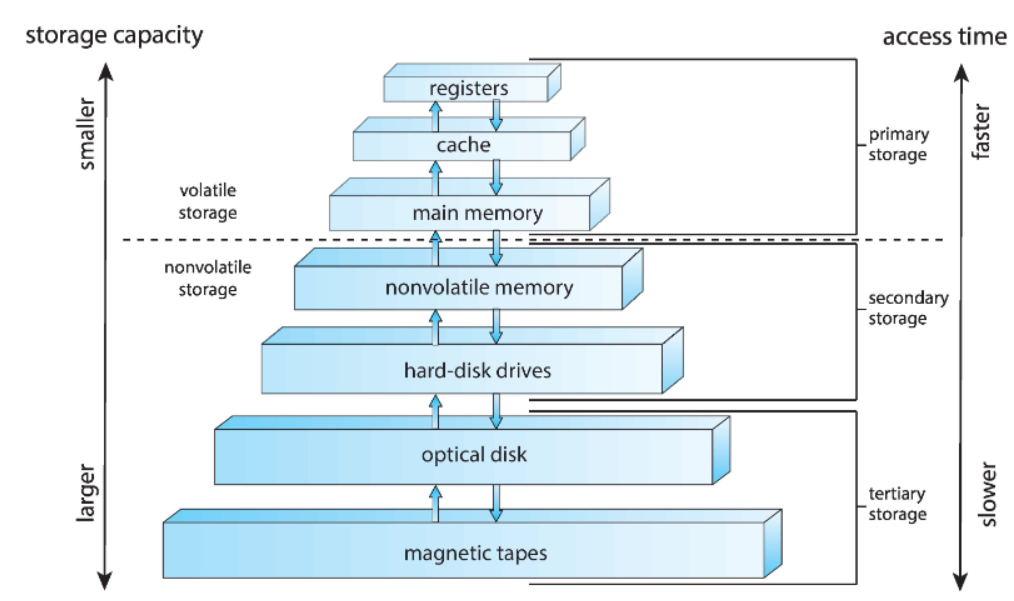
Storage-Device Hierarchy
register, cache는 CPU안에 내장되어있고 가장 빠르고 용량이 적으며 비쌈. 밑으로 갈수록 용량이 크고 느리며 가격이 쌈.
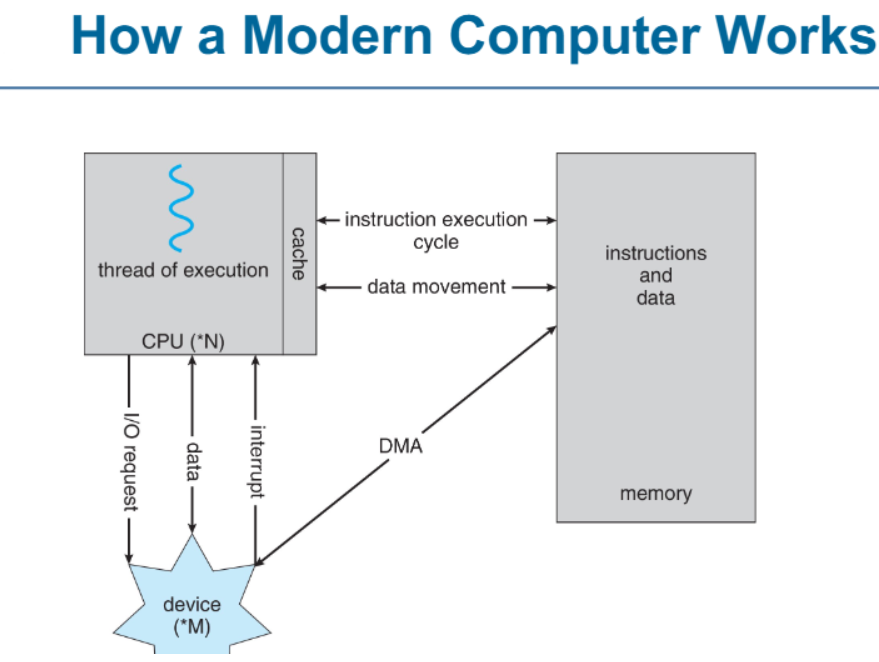
Working of Modern Computer
DMA(direct memory access)
- Used for high-speed I/O devices
- Device controller transfers blocks of data with out CPU intervention (CPU의 부하를 줄임)
- 큰 데이터를 CPU가 처리하려면 하나씩 옮겨서 오래걸리기 때문에 CPU가 모두 관여하지 않고 시작과 끝만 관여함
- Only one interrupt is generated per block, not per byte
Computer-System Architecture
- Most systems use a single general-purpose processor
- Most systems have special-purpose processors as well
- Multiprocessors systems growing in use and importance
- Known as parallel systems(병렬 시스템), tightly-coupled systems(밀결합 시스템)
✅Advantages of Multiprocessor:
- Increased throughput(처리량) - 작업을 더 빠르게 처리 가능
- Economy of scale
- Increased reliability: 일부 프로세서가 계속 작동하여 시스템이 완전히 중단되지 않음.
📝Types of Multiprocessor:
- Asymmetric Multiprocessing(비대칭 다중처리) - each processor is assigned a specific task
- Symmetric Multiprocessing(대칭 다중처리) - each processor performs all tasks
Symmetric Multiprocessing Architecture
Multiple Cores on a Single Chip
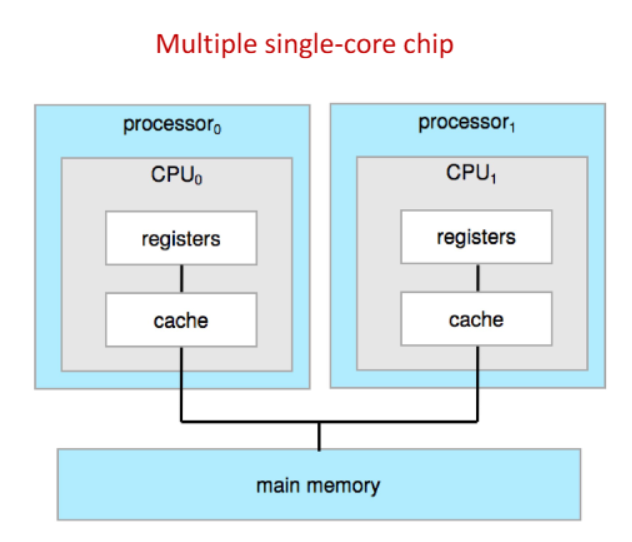
Symmetric Multiprocessing Architecture
- Multiple single-core chip
- 두 개의 개별 프로세서가 하나의 시스템에서 동작하며, 병렬 처리 성능을 향상시킴.
Multi-chip and Multicore Systems
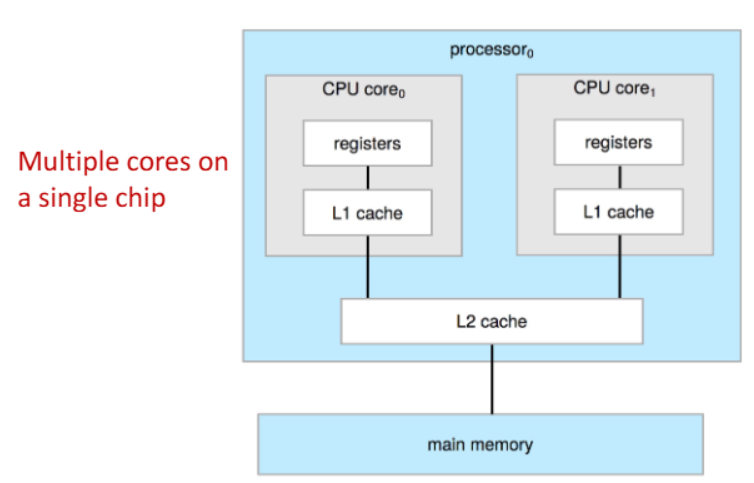
Dual-Core Design
- Multi-chip and multicore
- Systems containing all chips
- Chassis containing multiple separate systems(하나의 물리적 장치 내에 여러 개의 독립적인 컴퓨터 시스템이 존재하는 형태)
NUMA System
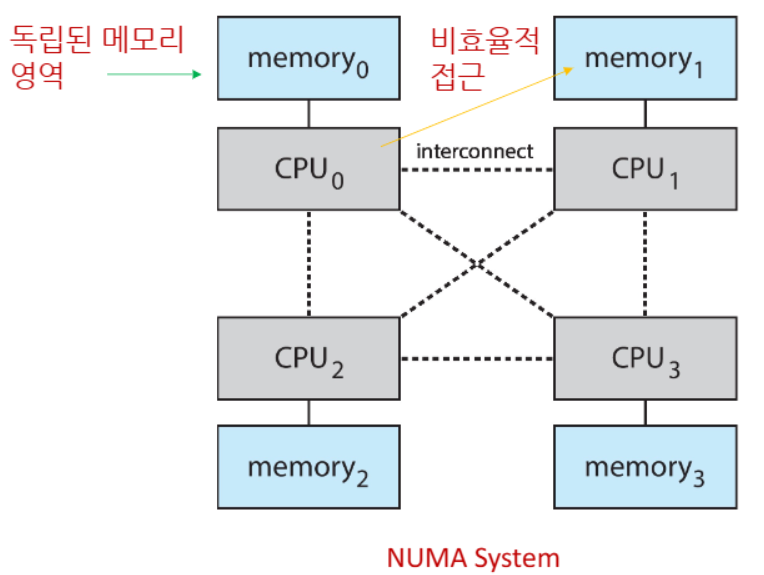
- 여러 개의 CPU가 각각 독립적인 메모리(memory) 영역을 가지며, 다른 CPU의 메모리에 접근할 수도 있는 구조
- CPU 간 데이터를 공유할 수 있도록 Interconnect(연결망) 이 존재
- Scalability(확장성)이 뛰어나지만 원격 메모리 접근은 성능 저하 를 초래할 수 있음
- ex: Server, Data Center etc
Clustered Systems
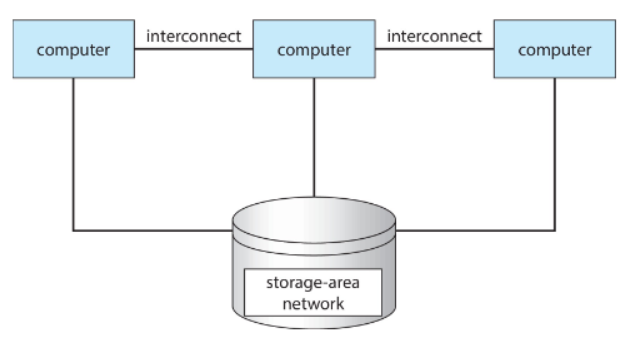
Clustered Systems
- Multiple systems working together
(즉, 여러 대의 컴퓨터가 하나의 네트워크로 연결되어 공동 작업을 수행하는 방식)
✅Features of Clustered Systems
- Storage Sharing
- 일반적으로 Storage Area Network(SAN)를 통해 여러 시스템이 동일한 저장소를 공유함
- 데이터 일관성 유지 가능
- Provides a High Availability
- 시스템 장애 발생 시 다른 노드가 대신 작업을 수행하여 서비스 중단을 방지.
- Asymmetric Clustering has one machine in hot-standby mode
- Symmetric Clustering has multiple nodes running applications, monitoring each other
- Some clutsers are for High-Performance Computing(HPC)
- App must be written to use parallelizaion(병렬 처리)
- Distributed Lock Manager(DLM)
- DLM to avoid conflicting operations on shared storage
- 데이터 무결성을 유지하고, 동시 접근 문제를 방지
Key takeaways
- 운영체제는 하드웨어 위에서 여러 프로그램이 자원을 나눠 쓰도록 조정하는 핵심 계층이다.
- 인터럽트는 운영체제가 I/O와 CPU 흐름을 제어하고 동시성을 다루는 출발점이다.
- 시스템 구조, 저장장치 계층, 아키텍처 개요를 먼저 이해하면 이후 프로세스와 메모리 파트가 훨씬 잘 연결된다.