
운영체제 설계와 구조의 원리 - Operating System 2-2
운영체제를 설계할 때 목표와 정책, 메커니즘을 어떻게 나누는지, 내부 구조와 구현 언어 선택이 왜 중요한지 정리합니다.
🍀 운영체제 전공 수업 정리
Operating system Design and Implementation
- OS Design is Not a Simple Problem(“Solvable”)
- However, some approaches have been successful
- 운영체제의 내부 구조는 다양함
- 하드웨어 및 시스템 유형에 따라 차이가 있음
- Start by Defining Goals and Specifications
- OS Goals:
- User Goals: OS should be easy to use, learn, reliable, safe, fast
- System Goals:OS should be easy to design, implement, maintain, flexible, reliable, error-free, efficient
✅Key Principle in OS Design
- Policy: “What will be done?”
- Mechanism: “How to do it?”
- Mechanism Defines Methods, Policy Determines Decisions
- 운영체제에서 정책과 메커니즘을 분리하면 유연성을 높일 수 있음
- Importance of Separating Policy & Mechanism
- 정책이 바뀌어도 메커니즘을 수정하지 않아도 됨
- Ex:
- Policy: Limit CPU usage time
- Mechanism: Use a timer to measure execution time
- CPU를 시간 제한을 두지 않으면 어느 한 사람이 독점해버리는 문제가 생길 수 있다
- 시간 제한을 두는 원칙을 Policy로 정했다면 어떻게 무슨 방법으로 시간을 제한할 건지 정하는건 Mechanism
- OS Design is a Highly Creative Software Engineering Task
Implement
OS는 다양한 언어로 구현됨
- 초창기: assembly language
- 이후: Algol, PL/1 등의 system programming languages
- 현재: C/C++
OS는 일반적으로 여러 언어의 mix임
- Lowest levels in assembly
- Main body in C
Systems programs: C, C++, Python, Perl, Shell Script
- Higher-Level Languages easier to **port** to other hardware, but slower(이식성↑, 성능↓)
- Emulation enables OS to run on Non-Native Hardware(비원본 하드웨어)
OS Structure
Various ways to structure ones
- Simple structure -
MS-DOS - More complex -
UNIX - Layered -
an abstraction - Microkernel -
Mach
Monolithic(단일) Structure - Original UNIX
단일 계층으로 되어있는 시스템
- 단일 계층: 계층화X, 한 개의 층에
file system,CPU Scheduling등등 다 넣은 구조 - Limited by hardware functionality and had minimal structuring
- 2가지 주요 구성 요소
- System Programs
- The Kernel:
- Operates below the system-call interface and above hardware
- Provides core OS functionalities(
File System,CPU Scheduling,Memory Management)
- 모든 기능이 하나의 레벨(one level)에서 수행됨(Monolithic Structure)
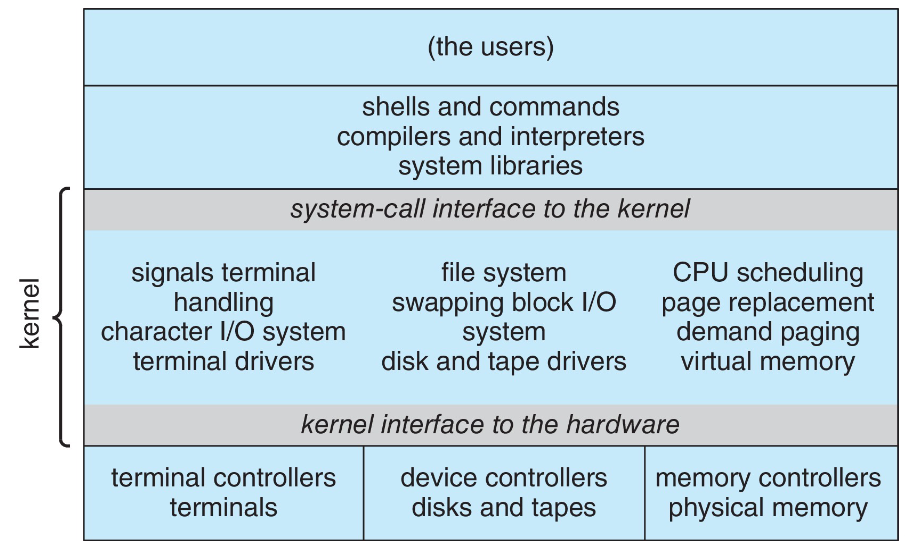
Original UNIX 모든 기능이 커널 내에서 하나의 레벨로 작동함
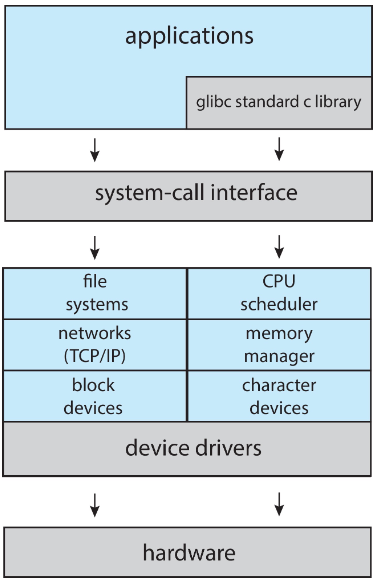
모놀리식 커널이지만, 모듈화를 통해 보다 유연하게 기능을 추가 및 제거할 수 있음
Layered OS Architecture
📚 The operating system is divided into a number of layers(levels)
- The bottom layer(layer 0) is the hardware; the highest (layer N) is the user interface
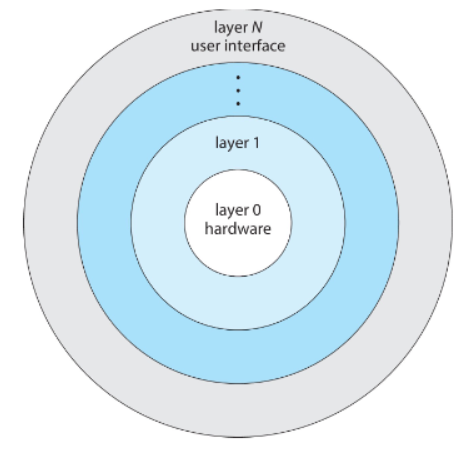
Layered
- With modularity, layers are selected such that each uses functions(operations) and services of only lower-level layers
- 상위 계층에서 하위 계층을 호출할 수가 있지만 반대는 안 됨
Microkernels
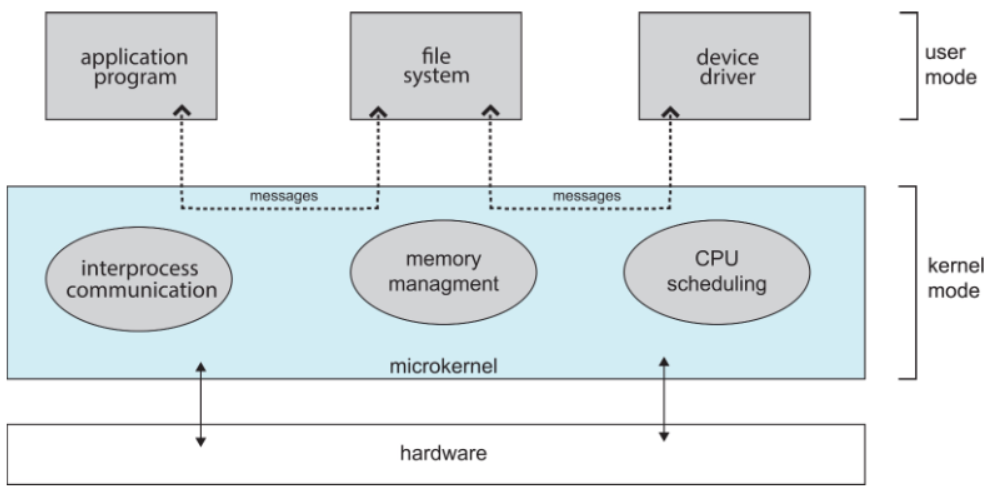
- Moves as much from the kernel into user space
- Mach example of microkernel
- Mac OS X kernel(Darwin) partly based on Mach
- Communication takes place between user modules using message passing
- 보통 사용하는 monolithic kernel에서는 API를 통해서(func call) 서비스를 제공하지만 microkernel은 message passing을 통해 제공함
- 그럼 function call을 단순히 messeage 형태로 바꾼게 아닌가?
- function call은 동기식이지만 messeage passing은 동기식, 비동기식 둘다 가능하다
- 동기식은 messeage가 올 때까지 기다리지만 비동기식은 메세지가 오면 나중에 확인하고 그때 회신하는 개념
✅ Benefits of Microkernel
- Easier to extend a microkernel: 새로운 기능 추가 시 커널을 직접 수정하지 않고 새로운 서비스 모듈을 추가하는 방식으로 확장 가능
- Easier to port the operating system to new architectures: 하드웨어 의존성이 낮아 새로운 아키텍처(CPU, 하드웨어)에 쉽게 port 가능
- More reliable: Kernel Mode에서 실행되는 코드가 줄어들어 운영체제가 더욱 안정적
- More secure
✅ Detriments of Microkernel
- Performance overhead of user space to kernel space communication
- Microkernel에서는 여러 사용자 모듈 간
Message Passing방식으로 통신해야 하므로, 성능 저하(Overhead) 문제가 발생할 수 있음.
- Microkernel에서는 여러 사용자 모듈 간
Modules
- Many modern operating systems implement loadable kernel modules(LKMs)
- Uses object-oriented(객체지향) approach
- Each core component is separate
- Each communicate to the others over known interfaces
- Each is loadable as needed within the kernel(필요할 때만 동적으로 로드 가능)
- Overall, similar to layers but with more flexibility
- Examples: Linux, Solaris, etc.
Hybrid Systems
- 대부분의 최신 운영체제는 단일한 순수한 모델이 아님
- Hybrid combines multiple approaches to address performance, security, usability needs
- Linux and Solaris kernels:
Monolithic+modular→ dynamic loading of functionality(새로운 기능을 쉽게 추가 가능) - Windows:
Monolithic+Microkernel→ for different subsystem personalities - Apple Mac OS X:
- hybrid, layered, Aqua UI plus Cocoa programming environment
Mach microkernel+BSD Unix+ I/O kit and dynamically loadable modules(called kernel extensions)
- Linux and Solaris kernels:
MacOS and iOS Structure
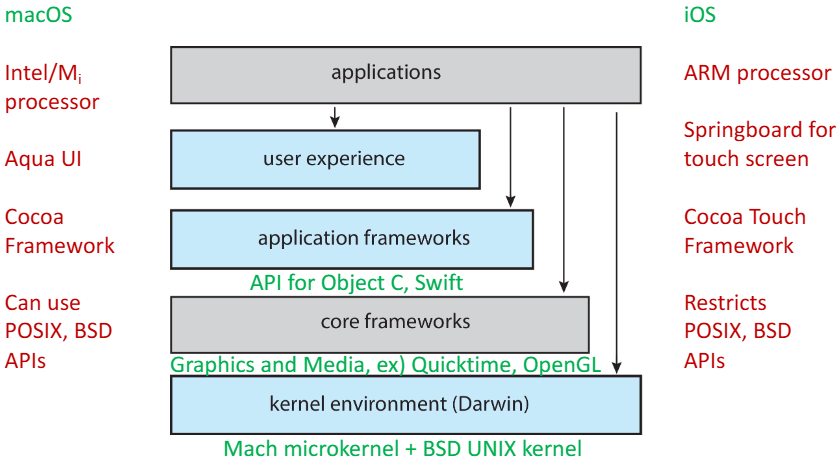
macOS and iOS Structure
Darwin Structure
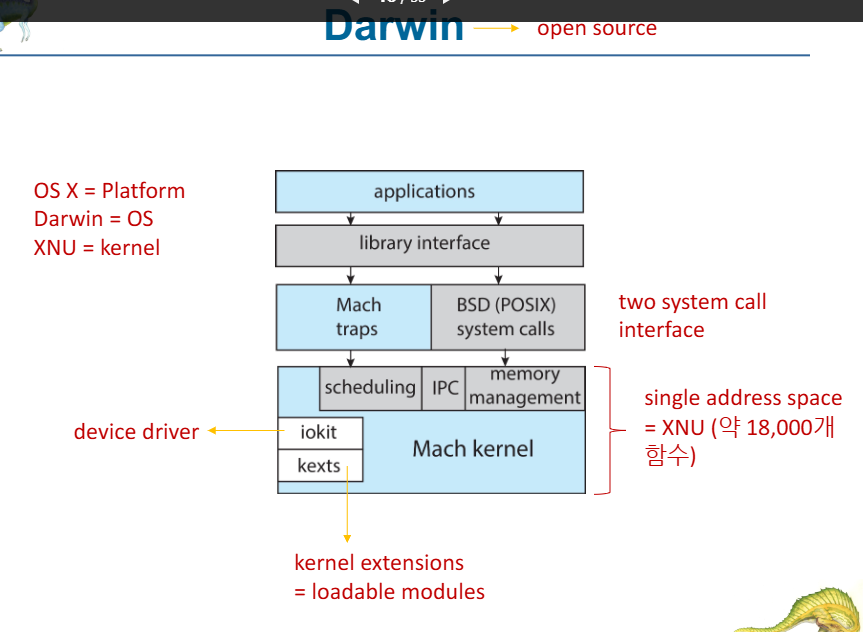
Darwin Structure
- Two System Call Interfaces
- Mach Traps: Mach 마이크로커널에서 제공하는 시스템 호출
- BSD(POSIX) System Calls: UNIX/POSIX 표준을 지원하는 BSD 커널의 시스템 호출
Android
Developed by Open Handset Alliance(mostly Google)
- Open Source
- Similar stack to iOS
- Based on Linux kernel but modified
process,memory,device-driver management제공- Adds power management
- Runtime Environment
- 핵심 라이브러리와 ART(Android Runtime) virtual machine 포함
- Apps은 Java 및 Android API를 기반으로 개발됨
- Java class files → Java bytecode 변환 → ART VM에서 실행
- Libraries:
web browser(webkit),database(SQLite),multimedia,smaller libc - Dalvik VM: JIT(Just-In-Time) Compilation
- ART VM: AOT(Ahead-Of-Time) Compilation
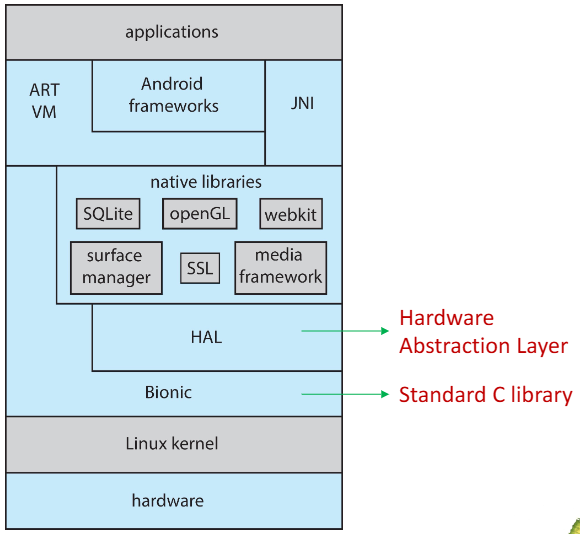
Android Structure
- ART(Android Runtime) VM: 안드로이드 애플리케이션 실행 환경
- JNI(Java Native Interface): Java 코드가 네이티브 C/C++ 코드와 통신할 수 있도록 지원
- HAL(Hardware Abstraction Layer): Hardware와 Software 사이에서 Hardware 기능을 소프트웨어적으로 접근할 수 있도록 지원하는 계층
System Boot
📚 When power is initialized on the system, execution starts at a fixed memory location
- OS는 하드웨어에서 사용 가능하도록 로드되어야 함 ✅ Booting Process
- BIOS / UEFI 실행 (Executing BIOS / UEFI)
Small piece of code가 ROM or EEPROM에 저장됨- 이를 통해 커널을 찾고, 메모리에 로드 후 실행
- Modern systems replace BIOS with UEFI (Unified Extensible Firmware Interface)
- Boot Block 활용 (Optional Two-step Process)
- Boot Block이 ROM 코드에 의해 실행됨
- Boot Block이 디스크에서 bootstrap loader를 로드하여 실행
- Bootloader Execution - GRUB 사용
- GRUB (Grand Unified Bootloader)를 통해 여러 OS 커널을 선택 가능
- Kernel Loads and System Running
- GRUB(Grand Unified Bootloader) 역할
- GRUB는 Linux에서 주로 사용되며, 다양한 부팅 옵션을 지원
- 부팅 시 사용자가 원하는 커널을 선택 가능
- GRUB는 open source로 개발됨
Operating System Debugging
📚 Debugging is finding and fixing errors, or bugs
- OS generate log files containing error information
- Core Dump & Crash Dump
- Core Dump와 Crash Dump는 프로그램 및 OS 오류 발생 시 필수적인 디버깅 도구
- Core Dump: 프로그램이 비정상적으로 종료될 때, 프로세스의 메모리 상태를 저장한 파일
- Crash Dump: 운영체제가 비정상적으로 종료될 때, 커널 메모리 상태를 저장한 파일
- Performance Tuning(성능 최적화)
- Trace Listings(추적 목록): 프로그램 실행 중의 활동을 기록하여 분석하는 기법
- Profiling: 주기적으로 Instruction Pointer를 샘플링하여 성능 분석
- Improve performance by removing bottlenecks(병목 현상)
- OS must provide means of computing and displaying measures of system behavior
- For example, “top” program(Linux) or Windows Task Manager
- Kernighan’s Law
- “디버깅은 코드를 작성하는 것보다 두 배 더 어렵다”
- “코드를 가능한 한 스마트하게 작성했다면, 디버깅을 할 만큼 똑똑하지 않을 가능성이 높다”
- 즉, 지나치게 복잡한 코드를 작성하면 디버깅이 어려워진다는 의미!!
Tracing
Tracing: Collects data for a specific event, such as steps involved in a system call invocation
→ 시스템이 어떤 순서로 어떤 자원에 접근하는지 추적 가능- 대표적인 트레이싱 도구들
strace: 특정 프로세스가 호출하는 system call을 추적함 (ex: 파일 열기, 읽기, 쓰기 등)gdb: GNU Debugger. 소스 코드 단위의 디버깅 도구 (breakpoint 설정, 변수 확인 등)perf: Linux 내장 성능 분석 툴 모음. CPU 사용량, 캐시 미스 등 하드웨어 성능도 추적 가능tcpdump: collects network packets
- 대표적인 트레이싱 도구들
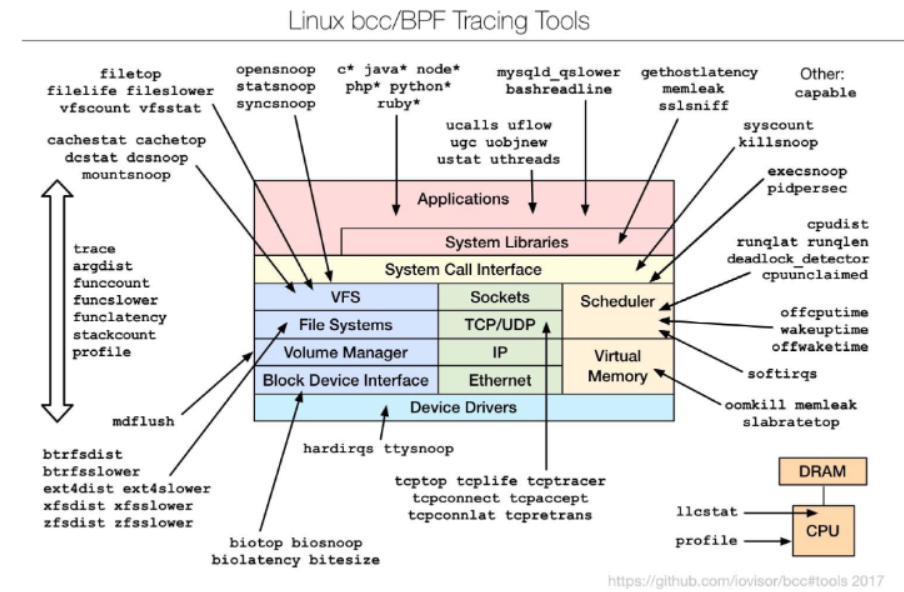
BCC
user-level code와 kernel code 사이의 상호작용을 debugging하는 것은 이를 모두 이해하고 분석할 수 있는 toolset 없이는 거의 불가능함
📚BCC = BPF Compiler Collection: 리눅스를 위한 강력한 트레이싱 도구 모음
- 기반 기술은 eBPF (Extended Berkeley Packet Filter)
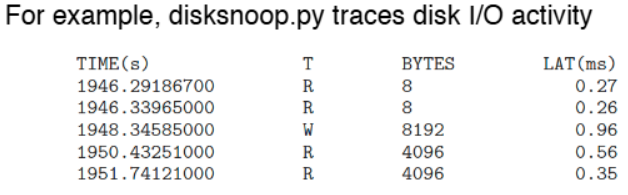
disk I/O 활동 추적 도구
Linux bcc/BPF Tracing Tools